
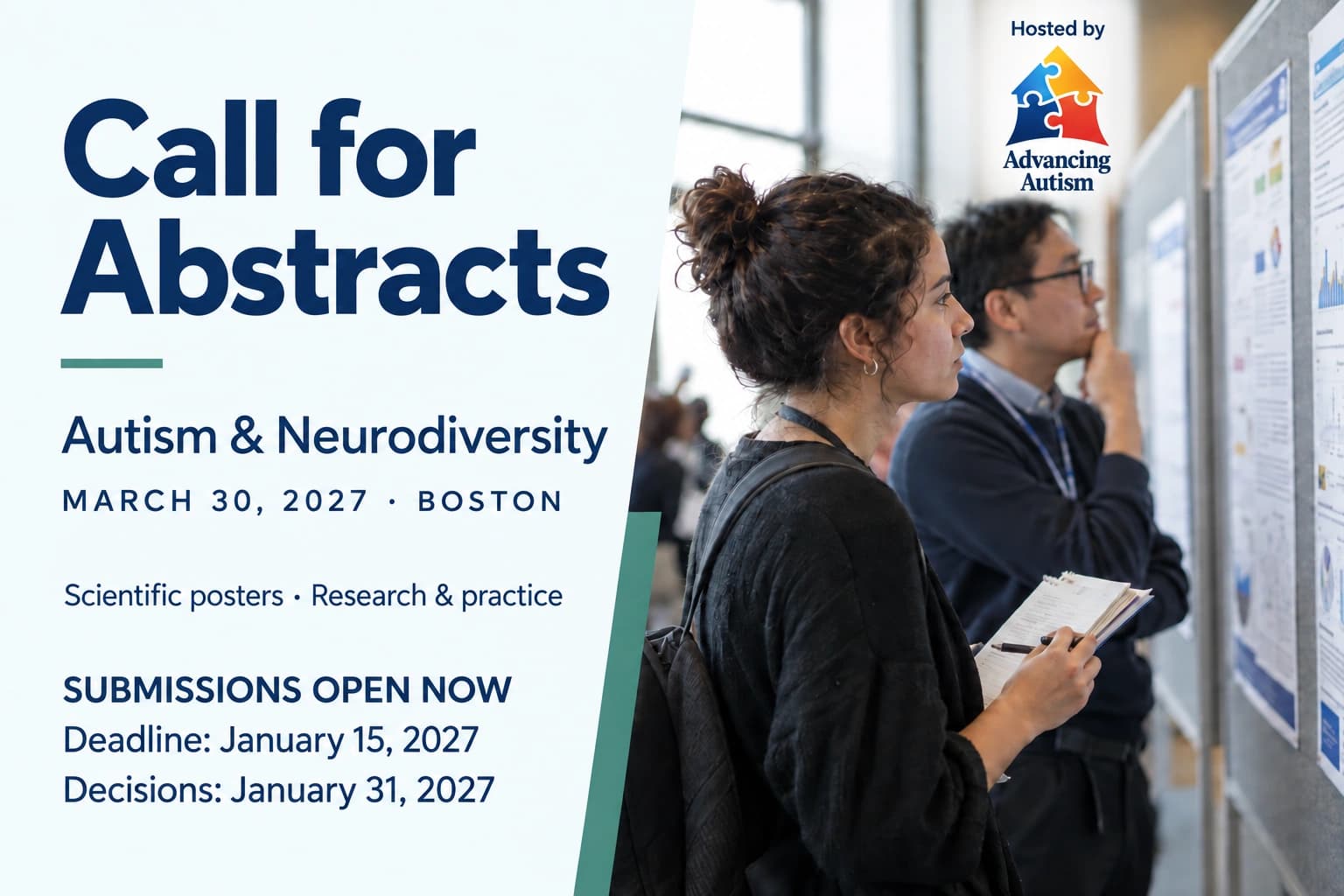
Call for Abstracts
Autism & Neurodiversity Scientific Symposium
From Developmental Neuroscience to Precision Diagnosis, Treatment and Future Care
· Boston
Joseph B. Martin Conference Center, Harvard Medical School, Boston
Submissions are open. Share research, clinical insights or an evidence-based student project through one of two distinct tracks. Accepted abstracts will be presented in person and included in the symposium proceedings.
Choose the track that fits your work.
We welcome interdisciplinary submissions. Select the category closest to your project; the two tracks use distinct requirements and review criteria. Completed work is encouraged, and well-developed preliminary, pilot, quality-improvement, educational, case-based and translational projects may also be considered.
Scientific & Professional Abstracts
For trainees, clinicians, researchers, educators and other professionals working in autism, neurodiversity, developmental neuroscience, clinical care and translational research.
What to include
- Title, presenting author, co-authors and institutional affiliations; funding information if applicable, and conflict-of-interest disclosure.
- An abstract body of no more than 300 words: Background / Objective; Methods; Results / Findings / Current Outcomes; Conclusions / Significance.
- The body word count excludes the title, author names, affiliations, funding information and conflict-of-interest disclosure.
- Preliminary or ongoing projects must report findings or current outcomes and clearly state the project’s stage of development.
Select a category
Developmental Neuroscience & Brain Mechanisms
Brain development; neural circuits; genetics and epigenetics; immune biology, the microbiome and gut-brain mechanisms.
Biomarkers, Precision Medicine & Therapeutic Innovation
Neuroimaging, EEG and eye tracking; biomarkers; clinical trials and therapeutic development.
Clinical Care & Co-occurring Conditions
Anxiety, mental health and neuropsychiatric conditions; sleep; occupational therapy, sensory regulation and coordinated care.
Communication, Learning & Education
Communication and AAC; behavioral and educational interventions; neuropsychology and learning; neurodiversity-informed education.
AI, Digital Health & Computational Precision Care
Artificial intelligence, computational approaches, digital biomarkers and technology-supported assessment or care.
Neurodiversity, Adulthood & Community Impact
Transition to adulthood, employment and adult health; participatory research; implementation science and health services.
High School Research & Innovation Track
For students currently in Grades 9–12. Projects may be completed independently, through a school or research program, or with a teacher or mentor. A university affiliation, laboratory experience or formal research mentor is not required; independent projects receive equal consideration.
Preliminary, exploratory and small-scale projects are welcome. Every submission must include inquiry, analysis, design or an evidence base. Awareness-only or advocacy-only presentations do not meet the research requirements.
What to include
- Title, student name, school and grade; co-authors and teacher or mentor information, if applicable.
- An abstract body of no more than 250 words: Question / Objective; Approach / Methods; Findings / Outcomes; Significance / Reflection.
- A separate Student Contribution & Project Origin Statement of up to 100 words: how the project began, what you personally completed, and any guidance or resources received.
Select a category
Brain, Behavior & Development
Projects investigating brain development, behavior, cognition or learning through a clear question and evidence.
Technology, AI & Innovation
Evidence-based designs, computational investigations and technology prototypes relevant to autism or neurodiversity.
Learning, Communication & Education
Investigations or tested designs concerning communication, learning environments and educational participation.
Neurodiversity, Community & Inclusion
Projects using inquiry, analysis, design or evidence to examine community participation, accessibility and inclusion.
Submission fees and review
Scientific & Professional Abstracts: $50 per submission. High School Research & Innovation Track: $25 per submission. Fees support review and poster-session administration and are separate from symposium registration. Payment does not guarantee acceptance. For both tracks, the fee is non-refundable once the abstract enters review.
Limited fee waivers may be available for trainees or applicants with financial hardship, including high-school students with financial need. Contact the team before payment to ask about availability and the request process.
Professional review
Members of the Scientific Committee and/or designated reviewers with relevant expertise assess scholarly quality, relevance, originality, methodological rigor, clarity and potential clinical, educational, scientific or community impact.
Separate high-school review
Reviewers consider the question, approach, evidence, originality, student contribution, understanding of limitations and potential impact, in the context of the resources available to the student. Access to a university laboratory, mentor or advanced equipment does not automatically confer an advantage.
If your abstract is accepted
The presenting author must register for and attend the March 30 symposium in person, prepare a printed scientific poster and take part in the designated poster discussion. Accepted abstracts will be displayed in the poster session and included in the symposium proceedings; this does not imply journal publication.
Provisional poster size: 36 × 48 inches, landscape. Final specifications will be provided after acceptance according to the venue’s display equipment. Wait for those instructions before printing.
The current poster-session plan includes viewing during designated breaks and/or lunch and formal discussion during afternoon networking. Exact times will be published with the final program.
Poster awards
Selected presentations may be recognized in the following categories. Awards are assessed using the submitted abstract and poster; final categories and eligibility will be published in the poster presentation guidelines.
- Outstanding Scientific Poster
- Outstanding Trainee Poster
- Clinical & Translational Impact Award
- Neurodiversity & Community Impact Award
- AI & Innovation Award
- Outstanding High School Research & Innovation Poster
Submission policies
Research Ethics & Responsible Conduct
Projects involving participants, interviews, surveys, personal or health information, or minors must follow applicable ethics, privacy, consent and school or institutional requirements. Projects using public or de-identified data must also meet applicable requirements. Do not include identifiable participant information in your abstract.
Previously Presented or Published Work
Work presented at another meeting may be considered. Disclose previous presentations or publications and identify any substantive updates. Duplicate abstracts and previously disseminated work remain subject to the Scientific Committee’s eligibility determination.
Author Responsibilities
Authors are responsible for the accuracy of their submission and must obtain agreement from every listed co-author. Clearly identify the presenting author. High-school submissions must accurately describe the student’s own contribution and any guidance or resources received.
Ready to share your work?
Complete your track-specific submission and continue to secure payment. For questions about eligibility, the high-school track, posters, awards, review or fee waivers, contact the team before submitting.
Connect with the people advancing care.
Help emerging research reach the people who can put it into practice. Discuss support for scientific posters, trainee participation and research exchange, with recognition agreed around your contribution.
Explore sponsorship opportunities